
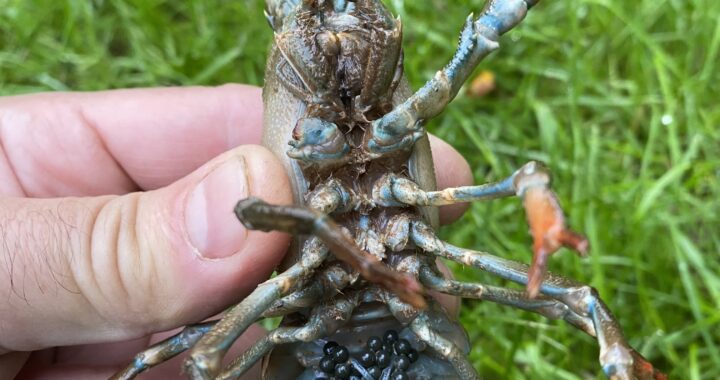
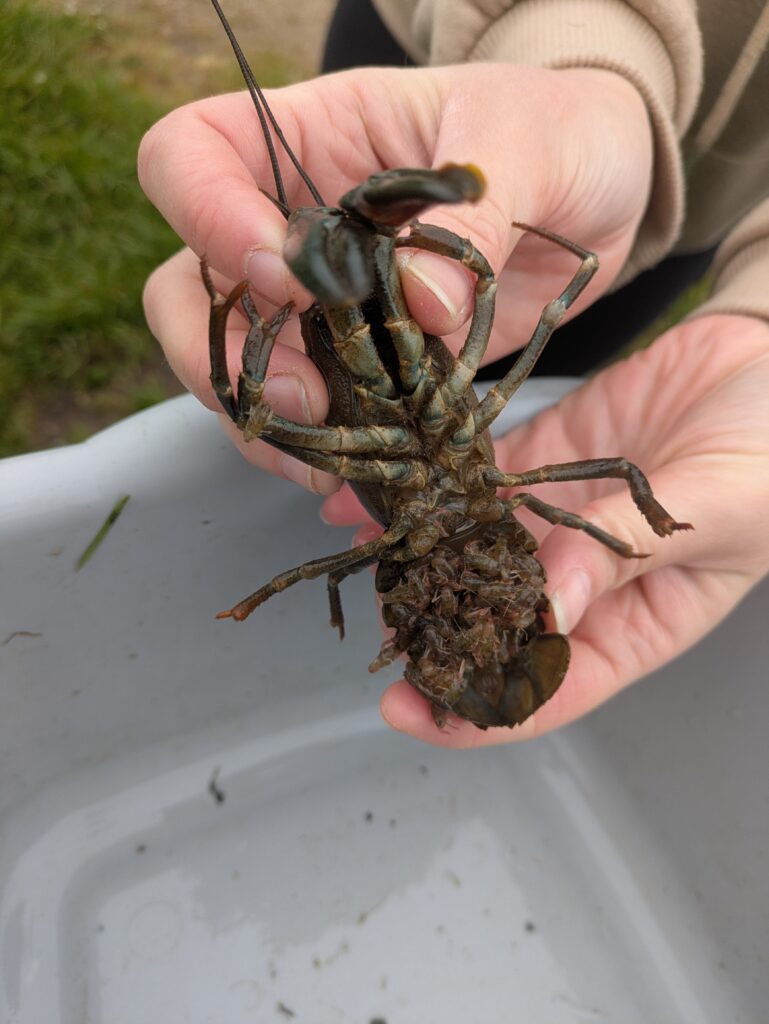
As of October 10th, we found our first berried female Signal Crayfish while undertaking work for our Signal Crayfish control project. The earliest we have ever found a berried Signal Crayfish is the 4th of October, across several years. But what does it mean for a female to be ‘berried’ anyway? Keep reading to learn about the bizarre world of freshwater crayfish reproduction.
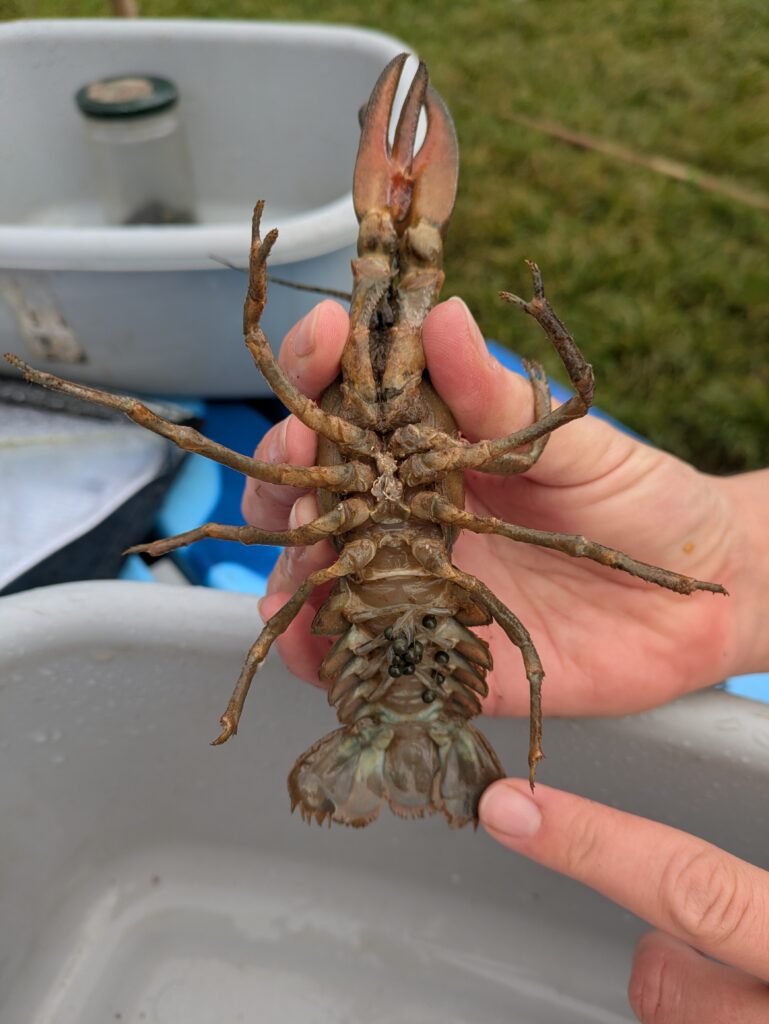
This female must have lost quite a few eggs.
Entering breeding condition
In autumn, as the temperature of the water drops and the days get shorter, sexually mature female crayfish develop a sticky blue-white substance on the underside of their tail called glair, released by the glair glands. Glair glands are distributed across the underside of the abdomen and the cephalothorax. Glair has two purposes:
- It attaches the female’s eggs to her pleopods (or swimmerets – the extra appendages on the underside of the tail that facilitate swimming).
- It dissolves the male’s spermatophore walls, releasing spermatozoa which will then fertilise her eggs.
But what happens when we aren’t looking?
Courtship
During breeding season, females will release chemical cues through their urine indicating their sexual receptivity. Interestingly, all crayfish release urine during fights, meaning urine release is a signal of aggression. But when fighting turns to romance, males reduce how much urine they release. Female urine therefore simultaneously stimulates aggression and courtship in males. Why?
In crayfish, courtship begins with a fight. Females experience a spike in aggression prior to mating, which is when urine is released. The pair will then wrestle. Females will then become receptive once a male can successfully flip her onto her back – she only wants the strongest, largest male!
Once the female is immobilised (indicating receptivity) and flipped, the male’s spermatophores (packaged spermatozoa) are then deposited on the underside of the female cephalothorax through his gonopods (the male reproductive structure).
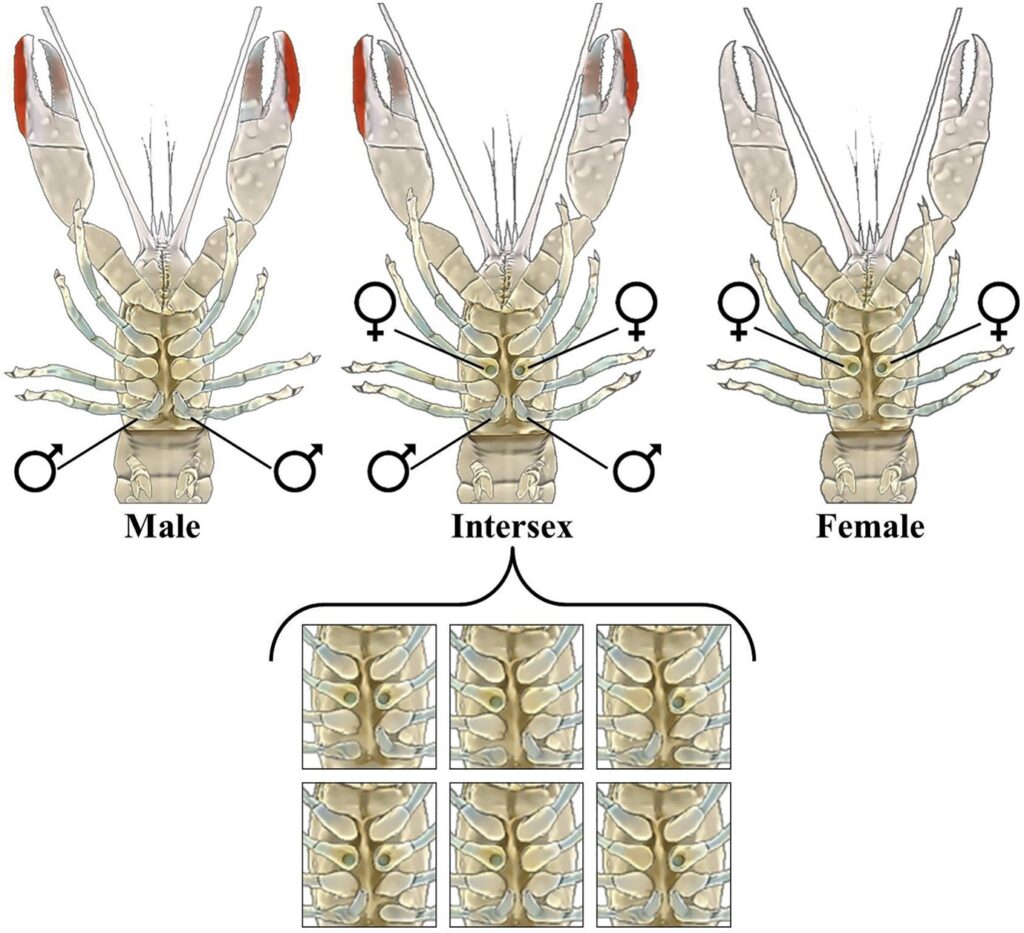
Image retrieved from Levy et al., 2020, displaying the male reproductive structure (gonopods) and the female reproductive structure (gonopores), as well as illustrating the possible sexual variations of an Australian redclaw crayfish.
However, if the male is not of suitable quality for her taste, she may remove the spermatophores, displaying mate selection. Females show a strong preference for males with both chelipeds (claws).
Offspring
Once the female has spermatophores deposited on her cephalothorax, she lays eggs through her gonopores (the female reproductive structure). She then secretes glair from her cephalothorax glair glands which dissolves the spermatophore walls, fertilising the eggs with the spermatozoa. The eggs are then attached to her pleopods, or swimmerets, with the help of glair.
A female carrying eggs is called a berried female – see the image below to find out why that is! Larger females can carry more eggs than smaller females. As Signal Crayfish get larger on average than White-clawed Crayfish, this is another way they are able to outcompete our native crayfish. A berried White-clawed Crayfish carries between 20-200 eggs, with an average of 80. Signal Crayfish, however, can carry over 300 eggs.
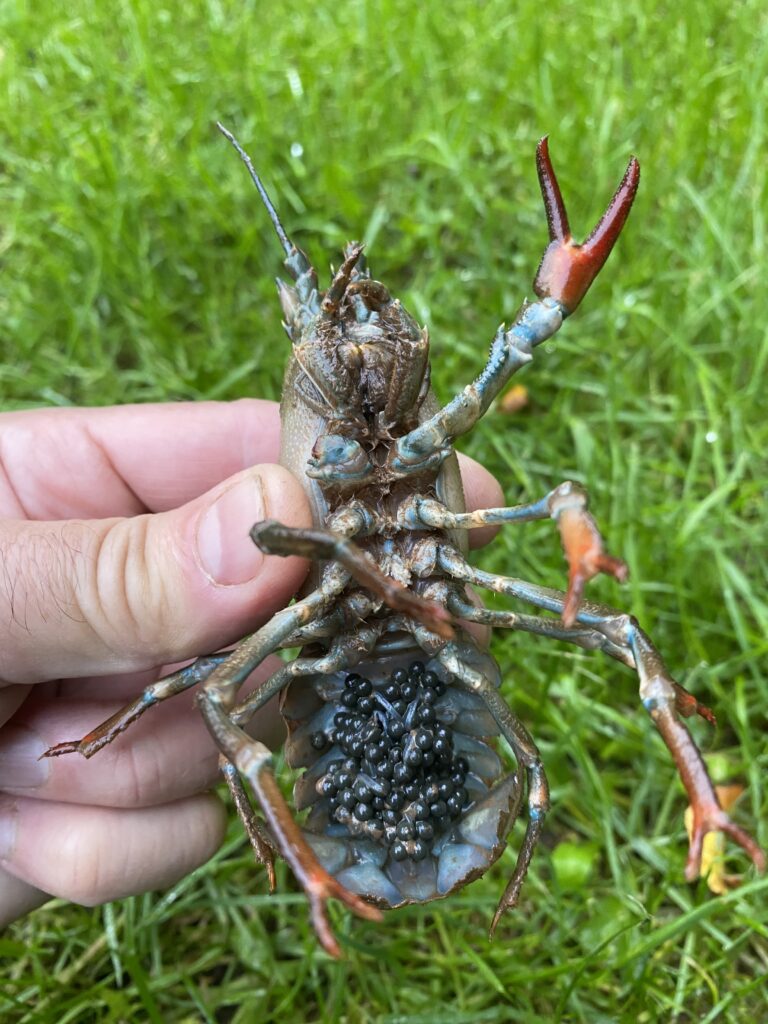
A female crayfish ‘in berry’.
Females carry their eggs for 6 to 9 months (species-dependent) – up to a whole human pregnancy – until the eggs hatch. She will fan the eggs to keep them oxygenated and will clean them with her swimmerets, showing parental care.
The hatchlings, or craylings, then stay attached to their mother’s pleopods for 2-3 weeks, where they first consume their yolk sac for nutrition, then begin to consume detritus and microorganisms from the safety of their mother’s body, then finally begin to detach for short periods of time to acquire food. From about mid July to mid September, their breeding season is over.
Hatchlings still attached to their mother; they will be literally hanging on by a telson thread.
References & further reading
Berry, Fiona & Breithaupt, Thomas (2010). To signal or not to signal? Chemical communication by urine-borne signals mirrors sexual conflict in crayfish. BMC Biology 8. https://link.springer.com/article/10.1186/1741-7007-8-25
Levy T. et al. (2020). Two Homogametic Genotypes – One Crayfish: On the Consequences of Intersexuality. iScience 23(11) https://www.cell.com/iscience/fulltext/S2589-0042(20)30844-0#fig2
Villanelli F. & Gherardi F. (1998). Breeding in the crayfish, Austropotamobius pallipes: mating patterns, mate choice and intermale competition. Freshwater Biology 40. https://www.researchgate.net/publication/229559494_Breeding_in_the_crayfishAustropotamobius_pallipesmating_patterns_mate_choice_and_intermale_competition
Mott, N. (2009) White-clawed Crayfish. Staffordshire Wildlife Trust, Stafford, UK. https://www.staffs-wildlife.org.uk/sites/default/files/2018-12/crayfish.pdf
Yazicioglu B., Reynolds J. & Kozák P. (2016). Different aspects of reproduction strategies in crayfish: A review. Knowledge & Management of Aquatic Ecosystems 417. https://www.kmae-journal.org/articles/kmae/full_html/2016/01/kmae160066/kmae160066.html
Exactly what I was looking for. Thanks!