Nottinghamshire Toad Patrols – 2024

The toad migratory season appears to be coming to an end and this will mark the end of Nottinghamshire Amphibian and Reptile Group’s toad patrols. The group has been patrolling roads throughout Nottinghamshire to prevent amphibian road mortality for the past two months and have helped incredible numbers of frogs, toads and newts to safely make their way to their breeding ponds.

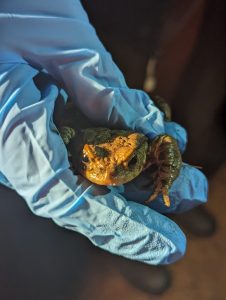
A male Common Toad saved from the road.
Image: Kayleigh Woodhouse

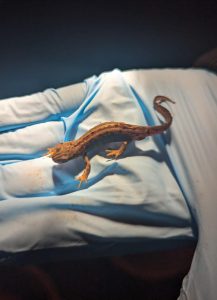
In total, Notts ARG’s patrollers have saved 1780 Common Toads, 41 Common Frogs, 80 Smooth Newts and 13 Great Crested Newts that otherwise would have likely become roadkill. Female Common Toads lay 1500 eggs per breeding season on average so these efforts will have benefitted the county’s toad populations enormously.

A male Smooth Newt saved from the road.
Image: Kayleigh Woodhouse

For more information on toad patrols, or to sign up as a patroller for next year’s migratory season, please contact Toad Patrol Coordinator Kayleigh Woodhouse at nottsargtoadpatrols@hotmail.com

Water Vole Recovery in Nottinghamshire

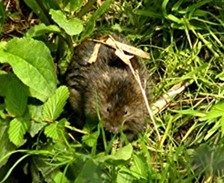
The Wildlife Trusts report that the Water Vole is the UK’s fastest declining mammal, mainly due to predation by the invasive American Mink, but also due to a loss of suitable habitat. In Nottinghamshire, water voles have disappeared from many sites where they were historically abundant.

A Water Vole
Image: Alan Smith

Last year, Nottinghamshire Wildlife Trust secured a grant from Natural England, which will allow them to begin to recover our water vole populations. The project will run until March 2025 and has 3 main aims:

  1. Control American Mink to limit water vole predation in 3 catchments (the Erewash, Sherwood and Idle)
  2. Increase habitat availability for the species around targeted rivers, by improving at least 10km of riparian habitat and creating new ponds.
  3. Reintroduce water voles to create an ark site at Idle Valley Nature Reserve.

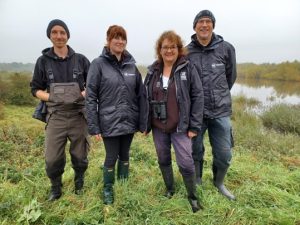
“Team Water Vole”
Left to right: Jack Scarborough, Lydia Rackham, Janice Bradley and Gary Cragg

Habitat improvement works will include the creation of 40 ponds close to existing watercourses, planting of new reedbeds, and the enhancement of riverbanks (as well as banks of lakes and ditches) which will allow burrowing sites for water voles. These works will also benefit other species, including otters, other small mammals such as harvest mice, bats and birds.

If you’d like to know more about the project, please contact Gary Cragg (Water Vole Recovery Project Manager) on GCragg@nottswt.co.uk

Life Cycle of the Grizzled Skipper Butterfly

The enigmatic Grizzled Skipper is a small, attractive black and white chequered butterfly, more commonly associated with calcerous grasslands in the south of England, but a rarity here in the East Midlands where it reaches the northern limit of its UK range. It is found at a few old quarry sites and on disused railway lines to the south of Newark and East Leake extending down to areas around Melton Mowbray. Many of these sites are found on private land and have been managed by the Notts BAG in collaboration with Butterfly Conservation to maintain their habitat.

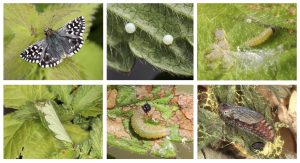
The butterfly is on the wing from the end of April and lays its eggs (ova) on the underside of the leaves of its preferred caterpillar food plants Wild Strawberry, Creeping Cinquefoil and Agrimony, particularly where they grow on short turf and bare ground in warm, sheltered spots. After about 2 weeks, the tiny larva (1 mm) emerges and crawls on to the top of the leaf and spins a loose protective net under which it feeds on the leaf surface. Over the coming months it sheds its skin in five stages as it grows. It continues to construct protective shelters or tents using silk ropes to draw together different leaves from its food plants. Towards the end of August it reaches full-size at around 20 mm where it takes on a pale green colouration with a black head. In this final stage it constructs a loose cocoon from a variety of vegetation and leaf litter on the ground. Within this secret hideaway it sheds its skin for the last time and then converts to the greenish/brown pupa. Remarkably, it spends 8 months hidden away, enduring everything that the Winter weather can throw at it, until it re-emerges at the end of the following Spring to the delight of anyone who chances upon one basking in the Spring sunshine, or roosting on a dead flower head late on a warm afternoon!

Images: Mark Searle

Many thanks to Mark Searle for this fantastic piece on the lifecycle of the Grizzled Skipper Butterfly. Please see here for more information on the Nottinghamshire Grizzled Skipper Project and here to see the Grizzled Skipper Species Action Plan.

Notts BAG Forum 2024

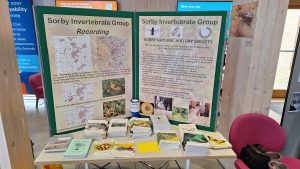
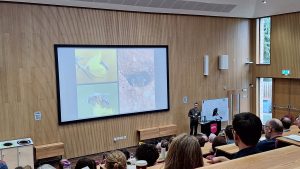
Last week we held the 2024 Notts BAG Forum, ‘Nottinghamshire’s Intriguing Invertebrates’, at NTU’s Brackenhurst Campus. The day consisted of 4 keynote speakers in the morning and 8 seminars, of which attendees had the chance to attend 2, in the afternoon. The talks were recorded and will be shared soon once they have been processed. Talks were given by a variety of specialists and displays from both national and local invertebrate organisations were set up in the foyer.

The aim of the event is to bring the Notts BAG partnership together to encourage discussion and debate and hopefully inspire the development of projects that contribute towards the targets in the Local Biodiversity Action Plan. This year’s theme, invertebrates, was chosen to raise awareness this often-overlooked group of species. It was fantastic to see over 60 Notts BAG partner organisations represented at the event, and we hope that the networking opportunity will generate action to benefit our wildlife.

We would like to thank everyone for coming and we really hope you enjoyed the day. We have created a feedback form and would really appreciate any feedback that you can provide, so that we can make next year’s Forum even better.

Photos: Shashwat Mohapatra, Owen King and Priyanshu Digambar Kamble

Clearwing Moth Surveying in Nottinghamshire

Melanie Penson, Conservation Officer for Butterfly Conservation East Midlands, recently held three training courses in Sherwood Forest, focused on identifying clearwing moth larval host trees. Clearwings are day-flying moths and their larvae are internal feeders, with all but one of our nine species boring into trees or shrubs where they can be larvae for at least two years.

Nottinghamshire is home to two Regionally Important species of clearwing – the Welsh Clearwing (Synanthedon scoliaeformis) and the Large Red-belted Clearwing (Synanthedon culiciformis), though neither species are found outside the Sherwood Forest area. Both species use birch trees as their larval hosts, with Welsh Clearwings favouring mature birch trunks and the Large Red-belted preferring birch stumps to lay their eggs. Over the two training days, 25 Welsh Clearwing larval host trees, and one Large Red-belted Clearwing larval host tree were identified and mapped.

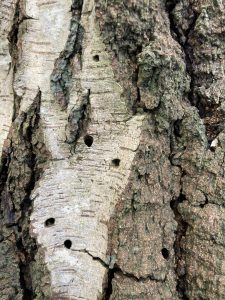
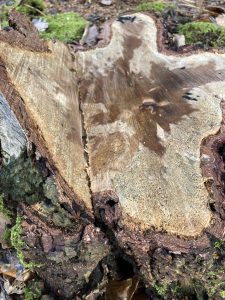
Welsh Clearwing exit holes.
Image: Kayleigh Woodhouse

Melanie said: “the majority of Welsh larval signs found would have been historic (Welsh was certainly present long before its discovery in 2008) but the aim was to show people what to look for, what type of trees and where to search”.

Large Red-belted Clearwing exit hole (bottom of picture)
Image: Kayleigh Woodhouse

Both species are affected by climate change, as they are upland species; Welsh Clearwings in particular are more geared to cooler summers. As Nottinghamshire is at the south-east edge of the Welsh Clearwing range in the UK and might also be at the lowest elevation above sea level, impacts of climate change will be felt here first. It is therefore essential that we maintain records of the distribution of these species so that we can monitor these effects.

Further training days are planned for 2024 – please contact Melanie at harfangneige2018@gmail.com for more information. Melanie will also be delivering further information on East Midlands clearwings at the upcoming Nottinghamshire Biodiversity Action Group Forum.

South Notts Ringing Group – Goldfinch Colour Ringing Project

South Notts Ringing Group have launched a colour ringing project to learn more about goldfinch survival, distribution and movement in the Nottingham area. This is the first project in Europe to use alpha-numeric colour rings on this species, and the success of the project relies on members of the public getting involved.

Each year the group collects data on over 300 goldfinches, but the recovery rate is less than 0.5%. The aim of their project is to understand where those birds go, and how many juveniles survive to become adults. By using colour rings, it allows individual birds to be identified and recovered without the need to catch them twice.

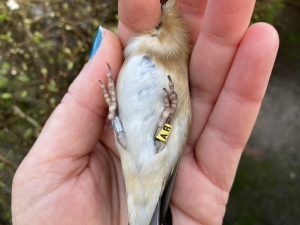
Goldfinch with colour ring.
Image: South Notts Ringing Group

If anyone sees a colour-ringed goldfinch, they should record the two-letter code as well as the date and location of their sighting and email it to: goldfinchresighting@gmail.com. They will receive the history of that bird, including where and when it was ringed, and where else it’s been seen. The rings are yellow with black text.

The colour ringing project is licensed by the British Trust for Ornithology (BTO) and is being conducted at sites in The Meadows and Sneinton. Birds are most likely to be recited within 10km of these sites, particularly in gardens where people are putting out food for birds.

South Notts Ringing Group has been run by volunteers since 1971 with the aim to collect and interpret data on bird’s distribution, migration, abundance, and climate related impacts. Bird ringing is a highly skilled activity and volunteers are trained to catch and handle birds so as not to harm them. The group is already involved in several long-term projects such as a constant-effort site at Attenborough Nature Reserve, 300+ owl and kestrel nest boxes, and colour-ringing peregrine, grey heron, cormorant, house sparrow, and little egret.

Notts Dormouse Project – 2023 Update

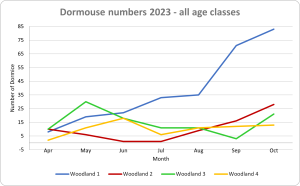
The Nottinghamshire Dormouse Group’s 2023 monitoring had highly variables results across the four main woodlands they work in. Woodland 1 returned record numbers of dormice towards the end of the season with 83 individuals recorded in October (the highest count prior to that had been 44 in August 2019) and Woodland 2 saw good breeding numbers, suggesting that the population is stable. Woodlands 3 and 4 recorded generally lower numbers than previous years. The cause of this is unknown – it may be the result of various factors including weather, food availability, disturbance, or the population reaching carrying capacity.

Over the weekend of 6th/7th January, the group hosted two ‘dormouse detector dogs’ from PAWS for Conservation (in partnership with the University of Greenwich). This was a very exciting trial, as the use of dormouse detection dogs would be useful for detecting hibernation nests prior to development work / woodland management, should the technique be deemed viable. The two dogs (Flo & Nala) underwent 2-years of training prior to their visit. On the Sunday, both dogs gave a strong indication at the location of a torpid dormouse. This was a positive result, though further trials will be necessary to show confidence in the detectability of dormice / effectiveness of the dogs.


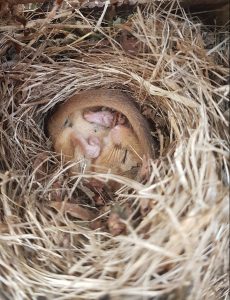
Torpid dormouse in nest box
Image: Lorna Griffiths

Click here for more information on the Notts Dormouse Group, and here for more information on PAWS for Conservation.

The Status and Recorded History of Nottinghamshire’s Butterflies (1850-2023) – Steve Mathers

Steve Mathers, Nottinghamshire’s County Recorder for Butterflies, has released a publication: ‘The Status and Recorded History of Nottinghamshire’s Butterflies (1850-2023)’. The report discusses the butterfly species present in the County since recording began in 1850, and how the composition of our butterfly fauna  has changed over time.

Image: Steve Mathers

The report is available for free as a PDF document – please contact Steve Mathers at smbutterflies11@gmail.com for more information, or to request a copy. Steve will also be running a seminar session about the publication at the upcoming Notts BAG Forum event – please contact us on biodiversity@nottscc.gov.uk for more information or to request a programme and booking form.

Toad Patrols – NARG

Common toads overwinter in shallow mud burrows, conserving their energy for the breeding season. Once temperatures are consistently above 5 degrees (usually February onwards), toads will begin to emerge, and make their way towards their ancestral pond to breed. Many toads have to cross roads to make their way back to their pond which often results in fatalities. Froglife estimate that 20 tonnes worth of toads are killed on UK roads each year (approximately 500,000 toads).

Image: Kayleigh Woodhouse

To combat this, Froglife set up the Toads on Roads project, which organises toad patrols in high fatality areas. Patrollers walk these roads after dark during the migratory period, picking up and moving any toads to the safety of their ponds. In Nottinghamshire, toad patrols are co-ordinated by the Nottinghamshire Amphibian and Reptile Group (NARG). In 2023, the group managed to save over 600 toads that were attempting to cross roads and they are hoping to recruit more patrollers this year, with the aim of saving even more toads.

If you would like to get involved, please contact NARG on nottsargtoadpatrols@hotmail.com with your location. You will then be provided details of your nearest toad crossing and advice on how to patrol.

Invasive Species Control Work in Birklands and Cuckney Haywood

Forestry England is working in partnership with HMPPS to deliver good quality Community Payback work placements in the nation’s forests. Building on the success of a pilot during the pandemic, in Greater Manchester and Merseyside, both partners agreed to roll out a new way of working together across the eleven probation regions in England over the next 3 years. In 2023 the Community Payback programme was established in Nottinghamshire.

The partnership will enable people on probation to learn new skills and receive training while completing their Community Payback requirement. One of the projects they will be working on is the invasive non-native species control work across Sherwood, focusing on Birklands and Cuckney Haywood.  Work is already underway to control Rhododendron and Cherry Laurel.

Rhododendron

Introduced to Britain in the 1700s as an ornamental plant, Rhododendron quickly spread (as a single plant can produce thousands of seeds each year). Rhododendron is also prone to spreading by vegetative means, sending out lots of lateral runners.  Each plant can grow up to 8m tall, causing it to shade and outgrow much of our native flora. Rhododendron can also act as a conduit for Phytophthora ramorum and Phytophthora kernoviae, two harmful tree diseases which detrimentally affect oak, beech and larch.

Cherry Laurel

Cherry Laurel was introduced to Britain in the 1600s and was planted widely as hedging. It is an ineffective food source for many animals as its fruit contains small traces of cyanide, making it unpalatable. It also shades out many competing plants, inhibiting both native flora and fauna where it is present.
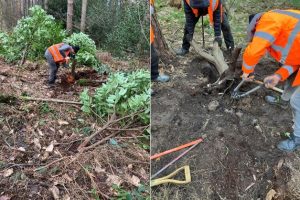
Tackling Cherry Laurel.
Images: Amy Chandler

Later this year, Forestry England and Community Payback will also be tackling:

Buddleia

Buddleia was introduced to Britain from China in the 1800s and was sold as an ornamental plant. Similar to Rhododendron, this species spread rapidly, as each plant can produce up to 3 million seeds per year. Though attractive to butterflies, and sometimes referred to as “butterfly bush”, Buddleia outcompetes native flora, reducing our biodiversity.

In 2023, IPBES reported that invasive species have contributed to 60% of plant and animal extinctions globally and are the main cause of extinction for 16% of species. It is therefore essential that we work to control these species and prevent their spread in the wild.

The Notts BAG partnership are working hard to control invasive non-native species – take a look at our INNS webpage to find out more about our work.