
What is the Himalayan Balsam Control Project?
The Himalayan Balsam Control Project started in 2011 and has been growing in scope and success since then. The primary goal of the project is to eradicate Himalayan Balsam, an invasive non-native plant.
Himalayan Balsam grows extremely quickly. It has the ability to spread its seed efficiently, with bursting seedpods that can throw seeds up to 7m from the parent plant. It prefers riparian habitats (but also does well in wet woodlands), which means that the seeds get thrown into watercourses and spread quickly down rivers, streams, and tributaries, easily colonising new locations.
The Control Project involves work parties of volunteers venturing out to problem sites where there are high balsam populations. The volunteers hand pick the balsam between May and early July, before the plant is ready to release its seeds, thus reducing, and eventually eliminating, the problem at these locations. Balsam seed is viable for 2-3 years, so if sites are managed repetitively for this period of time, then the plant can be eradicated.

Himalayan Balsam (Impatiens glandulifera)
Why Get Involved?
- Improving important habitats
Himalayan Balsam prefers moist soils and is most often found along riverbanks and in ditches. As a result the plant can very quickly gain a chokehold on riparian habitats that are vitally important for species, some of which may be threatened and vulnerable. By removing Himalayan Balsam, our work repairs important wetland habitats, enabling our native fauna to exploit them to their advantage.
By joining the project, you would be working to protect and enhance these vitally important areas of habitat.
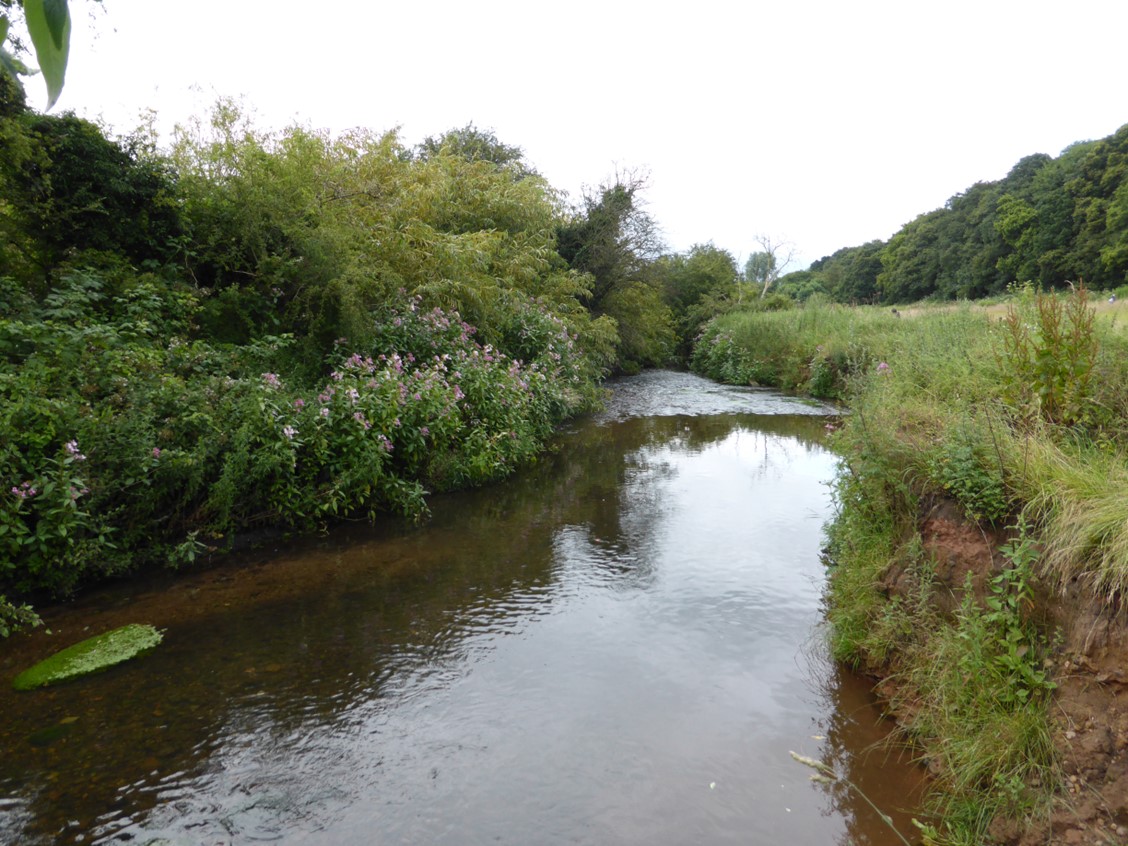
Himalayan Balsam alongside Maun Valley Park in 2014. This area is now free from balsam.
- Biodiversity
Invasive species threaten biodiversity, and Himalayan Balsam is no exception. The plant is able to form large swathes of foliage along riverbanks which creates a monoculture, reducing the biodiversity of the habitat, and the resources available for our native species.
Himalayan Balsam is an annual plant that dies back during the winter months. As a result, the riverbanks are left devoid of vegetation during winter, leaving little (or no) cover for riparian species such as kingfisher, water vole and water shrew. This makes these species vulnerable to predation, so they are forced to leave. Also during the winter dieback of Himalayan Balsam, riverbanks are left without the root systems that bind the soil, holding it in place. Without these roots, large areas of riverbank are left vulnerable to erosion and flooding. The increased risk of erosion leads to siltation of the channel, which can often lead to the loss of fish spawning grounds.
Himalayan Balsam is also incredibly attractive to our pollinators due to its abundant nectar production. Studies have shown that pollinators will preferably visit Himalayan Balsam over our native flora, which results in many of our favourite plants failing to seed.
By joining the project and assisting with the eradication of Himalayan Balsam, you will play a vital role in conserving Nottinghamshire's biodiversity.
- Community
By getting involved with the project, you would be joining a county-wide movement. As the project is volunteer-driven it provides a great opportunity to network and meet like-minded individuals who are also keen to take a hands-on approach at conserving Nottinghamshire's natural assets.

Volunteers pulling balsam on the River Leen
- Health Benefits
The project consists of volunteer work parties tackling the problem on rivers in central-west Nottinghamshire (e.g River Erewash, River Leen, River Maun etc...). The volunteers control Himalayan Balsam by pulling the plant by hand. The work can be hard and physical, but is overall very rewarding. This can have a positive impact on both physical and mental health.
Sign up today!
If you are interested in joining the Himalayan Balsam Control Project or would like any further information please contact us by email at biodiversity@nottscc.gov.uk.
Keep an eye on our Events Page
Also, keep an eye on our Events Page as Himalayan Balsam work party dates will be added to our group calendar.