
What is the current problem?
Forestry England manages multiple woodlands across Nottinghamshire. Rhododendron is present at many of these woodlands and is having an adverse affect on the native biodiversity. These large shrubs overpower their surroundings and prevent other plant species from growing, killing native species, and causing a loss of ecological diversity. Removing invasive non-native species is a vital step in saving nature, and the NottsBAG partnership promotes the removal of many harmful species. Forestry England have taken up the gauntlet in the fight against invasive species and are actively removing Rhododendron from their sites across Nottinghamshire. These sites include Birklands and Watchwood Plantation in Sherwood, and Stapleford Woods near Newark.
Issues with Removal
Eradicating a species from a site is a lengthy task that often extends across multiple years of regular management. Intensity, cost, and time of a removal project will differ depending on the extent of the rhododendron patch. Rhododendron spreads rapidly by a process known as layering, which involves lateral branches re-rooting to create clones of the plant. A singular plant can very quickly turn into a dense patch of multiple plants. Ideally, plants will be removed when they are young, but this is not always possible.

Patches of Rhododendron in woodland
Control Methods
Forestry England use a variety of methods to control Rhododendron. These range from simpler techniques, to the use of large machinery and herbicides.
Hand Pulling
The cheapest and quickest way to remove Rhododendron is to simply pull it out by hand. This requires little equipment, just gloves and hand tools for cutting branches and roots. If plants are small enough their roots may pull out with the rest of the stem. Larger plants are likely to have thick, deep roots which are hard to remove. With mature Rhododendron, the entire root ball must be removed so the plant cannot re-establish itself.
Using a Roboflail
A Roboflail is a type of remote-controlled mower with a sturdy flail attached at the front. These mowers can be used on sloping ground, making rhododendron removal much easier in difficult areas to access. A single machine can tackle much taller rhododendron plants and cover larger areas in a shorter amount of time. The machine cuts through the plants stems to stunt growth, but the roots remain intact below ground. To ensure the plant stops growing, a follow up spray of herbicide will often be applied once some leaves have regrown. Although this process can have the desired effect after just one treatment, sometimes a follow up is needed due to the resistant nature of the plant.
Ecoplugging
Ecoplugs are small capsules that contain granules of herbicide that can assist in killing hardy tree stumps. A hole is drilled into the stump, and the plug is inserted into it. Once the plug is installed the glass liner breaks, and the granules of herbicide are released into the remainder of the plant. This should prevent the roots from putting out new growth and eventually the stump will rot away. Forestry England try not to use these if possible, to minimise the use of chemicals and plastic, but they are useful in sensitive habitats that would struggle with the disturbance caused from other methods.

Ecoplugging Rhododendron stumps
What has been achieved so far
Forestry England have had brilliant results across their sites in Nottinghamshire. Amy Chandler, Community Ranger at Forestry England, has been leading the work on hand pulling Rhododendron for the past 10 years. Currently, approximately 30 hectares of rhododendron has been removed from 5 different sites.
Over a two year period, Forestry England have worked with their volunteers to remove rhododendron from their Birklands site in Sherwood. This work involved hand pulling rhododendron from an area that is equivalent to 20,000 square metres. Local college students, the sites “Friends Of” group, weekly practical volunteers, and NTU students all contributed to this project.
At Stapleford Woods, on the Nottinghamshire/Lincolnshire border, Forestry England have been using Roboflails to clear rhododendron. The rhododendron at this site is widespread. Depending on several factors, such as budget, time, and weather conditions, Forestry England have been able to remove around 10 hectares a year from this woodland.
If you have any further questions or are interested getting involved yourself, get in touch with Amy at amy.chandler@forestryengland.uk.
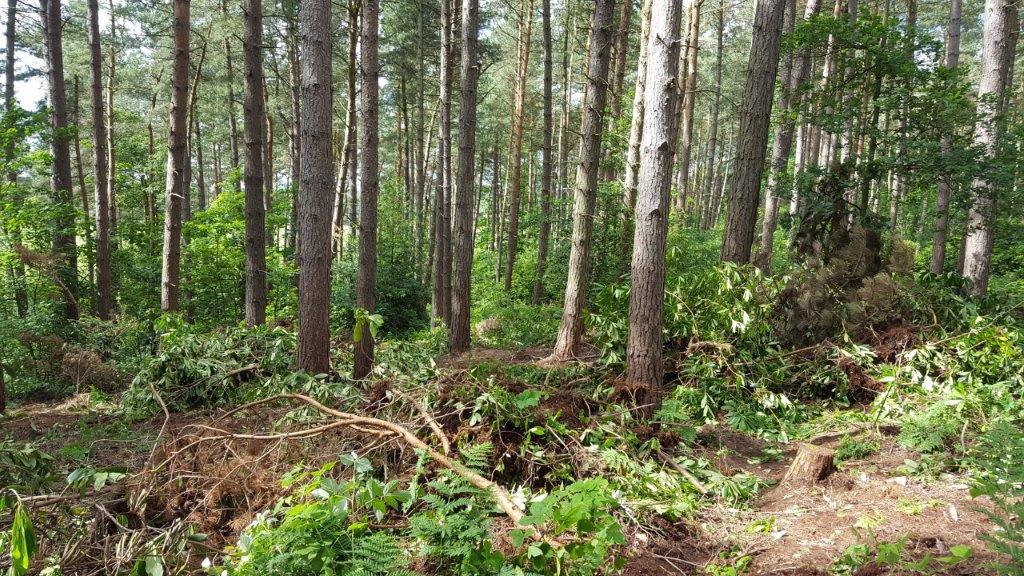
Removal of Rhododendron