
What is the current problem?
Nottinghamshire County Council (NCC) Green Spaces manage multiple greenspaces across Nottinghamshire, many of which are made accessible to the public for recreational purposes, including the enjoyment of local wildlife. Japanese Knotweed is currently present on 12 of these sites and can be inadvertently spread with adverse effects on biodiversity, due to its ability to grow rapidly and suppress other plant growth. The economic impact of removal is huge with the average cost to treat a 5m x 5m stand estimated at £5800 (CABI, 2010).
Issues with removal
Japanese knotweed can sprout from the smallest of shoots and if the plant is not completely eradicated, regrowth will occur. It takes on average 3 years of sustained chemical treatment to remove the plant and prevent its spread, with annual visits required post-treatment to check for any new shoots. NCC have implemented a programme of treatment to eradicate it from their sites across Nottinghamshire .
Often, stands of knotweed are found in areas of dense scrub and vegetation, which can make identifying the stand difficult in the first instance, as a result, this can allow it to become well established before it is noticed. Accessing a stand to treat it in dense vegetation can also be difficult. If conditions permit, Land Managers may decide to mark out the extent of a stand during the growing season, and then clear the area of all vegetation during the dormant winter months (burning the arisings on site) so that new stems can be more easily identified and treated the following summer.
The problems associated with eradication can be compounded if an infestation straddles ownership boundaries, or if the ownership of adjacent land containing the infestation is not known or registered. Owners need to work together to coordinate their approach to eradicate knotweed in such circumstances, and this can often be problematic.
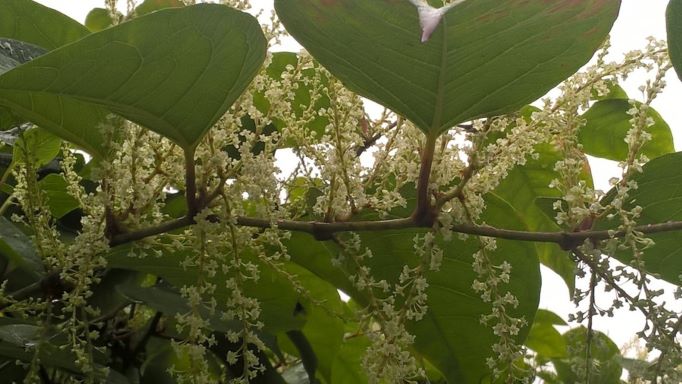
Japanese Knotweed in flower
Control Methods
There are several methods that can be used to control Japanese knotweed, including mechanical removal and chemical control. As it is classed as controlled waste under the Environment Protection Act 1990, specialised contractors with appropriate licenses are employed by NCC to eradicate and control it. Chemical control is known to be effective in the treatment of Japanese Knotweed but if chemically treated (which includes any surrounding soils), the Hazardous Waste Regulations 2005 apply. Within the sites managed by NCC, only chemical methods are used, as this is known to be the most effective.
Chemical control
Direct injection
Where possible, the herbicide glyphosate is injected into individual hollow stems in May/June and September. This method is suitable for larger plants and ensures that the herbicide is specifically targeting the knotweed without collateral damage to other vegetative species and any adjacent waterbodies. Foliar application is used for regrowth and stems which are too small and spindly for injection.
Foliar herbicide application
Where stems are too small to inject, glyphosate is applied by spraying emerging leaves in spring with a follow up application in autumn. This encourages the chemical to translocate to the rhizome as the plant prepares to overwinter. Extreme care is taken by specialist contractors to ensure safe use of the herbicide, protection of soils, groundwater and watercourses. If chemical control is to be used near a watercourse, a licence must be applied for from the Environment Agency. Annual visits are undertaken on known sites, even after treatment has ceased, to check that no shoots have re-appeared.
Mechanical Removal
Cutting and burning
Onsite cutting and burning of stands has previously been completed at some sites and although does not eradicate the problem, can weaken plants and aid follow up treatments. Great care is taken by specialised contractors to ensure that fragments of the plant are not spread outside of the infected area, and topsoil is removed to expose rhizomes prior to burning.
Burying
This method has been used at sites where it is possible to bury the stand on the site where it is found. The stand needs to be buried to a depth of 5m, with a root membrane cover to stifle regrowth.

Injecting glyphosate into the stems of Japanese Knotweed
What has been achieved so far
Using chemical methods, NCC have achieved a significant reduction in the number of stands of Japanese Knotweed on land under their control over the last six years Nottinghamshire County Council have successfully eradicated Japanese Knotweed on 8 sites and continue to treat plants on a further 12. All the sites with treated plants have seen a reduction in the number of recurring shoots and they will continue to be monitored for several seasons after the last stem is eradicated.
Success rates for treatment vary greatly. In one instance at a site near Worksop, NCC treated a stand of 90 stems in the highway verge in June, with a follow up foliar treatment in September. The stand was successfully eradicated in one season, with no further stems being recorded in the three seasons following treatment.
On other sites, stands have found to be more far more resilient, and this may be down to the length of time the plant has been established. At Nunn Park, Huthwaite, a stand of Knotweed has been treated each year in June and September since 2015, with stems peaking in 2017 at 125 stems injected and 215 smaller stems foliar sprayed. In June 2022, this number has reduced to 0 stems injected and only 8 small stems sprayed. Although a significant reduction, the site will continue to be visited over the coming seasons.
Other partners that have supported the control of Japanese Knotweed include:
Ashfield District Council, Broxtowe Borough Council, The Canal & River Trust, The Environment Agency, Forestry England, Mansfield District Council, National Trust, Nottingham City Council, Nottinghamshire Wildlife Trust, Rushcliffe Borough Council and Trent Valley Internal Drainage Board
For more information about Japanese Knotweed, please follow the link to the GB non-native species secretariat factsheet.
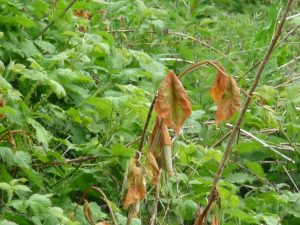
Japanese knotweed post foliar herbicide application
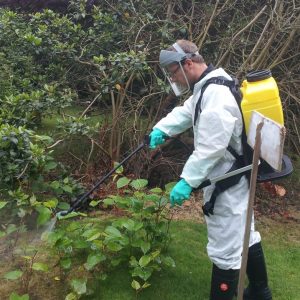
Foliar herbicide application