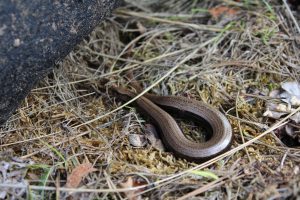
Slow-worm | Anguis fragilis
Species Action Plan
Authors: John Osborne and Kayleigh Woodhouse
Lead Agency: Forestry England
Publication date: January 2024
Planned review date: 2026
Current status
The Slow-worm is a commonly recorded reptile found across the UK. It is widespread in the south of England and becomes increasingly scarce in central and northern areas. In Nottinghamshire, the Slow-worm is one of three native reptile species that are regularly recorded each year.
Slow-worms can be found in a variety of natural habitats but also occur on disused railway embankments, allotments, and brown-field sites. They spend much of their life below ground and are mostly encountered when basking in secluded sunny spots. Slow-worms prey on slugs, spiders and other invertebrates.
From available data, Slow-worm populations in Nottinghamshire are concentrated in Greater Nottingham, and around Worksop, where the highest known populations in the county occur (more than 50 individuals recorded at one site).
Slow-worm were recorded in 33 1km squares prior to 2003. Records show a decline in their distribution to 24 1 km squares between 2004-2013, followed by an increase in distribution to 31 1km squares between 2014-2023. This increase in distribution however is undoubtedly a reflection of increased recorder effort over the same period.
| Period | Pre-2003 | 2004-2013 | 2014-2023 |
| No. of 5km squares | 24 | 12 | 17 |
| No. of 1km squares | 33 | 24 | 31 |
Targets
- Maintain the current (2014-2023) distribution of Slow-worm.
- Increase the distribution of Slow-worm to 32 1km2 areas by 2026.
Threats
- Habitat loss due to development, or changing land use (e.g. agricultural improvement and afforestation).
- Lack of habitat management, with a loss of open areas due to scrub encroachment.
- Over-tidying, mowing and strimming, and overgrazing which reduce available basking and hibernation sites.
- Habitat fragmentation, which creates small, isolated populations that are vulnerable to localised extinctions.
- Persecution due to misinformation and fear.
- Disturbance from public access to the countryside, and predation from domestic pets and game birds.
Current initiatives
- Criteria have been agreed by the Nottinghamshire Local Wildlife Sites (LWS) Group in relation to the designation of LWS for Slow-worm. These sites are in the process of being mapped.
- The Nottinghamshire Amphibian and Reptile Group conduct surveys for Slow-worm at a number of sites throughout the county
Proposed action
Site safeguard and management
- Manage current sites to maximise suitable habitat, improve connectivity between colonies, and, where possible, look to expand habitat to allow Slow-worm to increase their range.
- Determine ownership of known Slow-worm sites and inform landowners, making them aware of the habitat requirements for the species and encouraging them to include Slow-worms in their site management plans.
Future research and monitoring
- Improve the recording of Slow-worms in Nottinghamshire, by increasing survey efforts, following up old records, and encouraging the sharing of data.
- Establish a recording schedule for known sites (e.g. every 3 years).
- Undertake research using GIS to identify where unrecorded Slow-worm populations may be present.
- Highlight areas of possible habitat expansion using data from the Nottinghamshire Biodiversity Opportunity Mapping Project.
- Consider the potential for Slow-worm introduction to sites with appropriate habitat, in line with IUCN1/DEFRA2 guidelines.
Communications and publicity
- Raise public awareness of the species
- BAG partner organisations to promote their work on Slow-worm conservation.
Advisory
- Create guidance for site managers, gardeners and allotment associations on how to manage land for Slow-worm, including a request for any records to be submitted to the Nottinghamshire Biological and Geological Records Centre.
What can you do?
- Report sightings of Slow-worm (to the Nottinghamshire Recorder for Amphibian and Reptiles, the Nottinghamshire Biological and Geological Records Centre or on Record Pool).
1IUCN, 2013. Guidelines for Reintroductions and Other Conservation Translocations. Guidelines for reintroductions and other conservation translocations | IUCN Library System
2DEFRA, 2021. Reintroductions and Conservation Translocations in England: Code, Guidance and Forms. Reintroductions and conservation translocations in England: code, guidance and forms - GOV.UK (www.gov.uk)