Diamond-backed Spider | Thanatus formincus
Species Action Plan
Authors: Dr Helen Smith and Kayleigh Woodhouse
Lead agency: British Arachnological Society and National Trust
Publication date: 19/10/2023
Planned review date: 2027
Current status
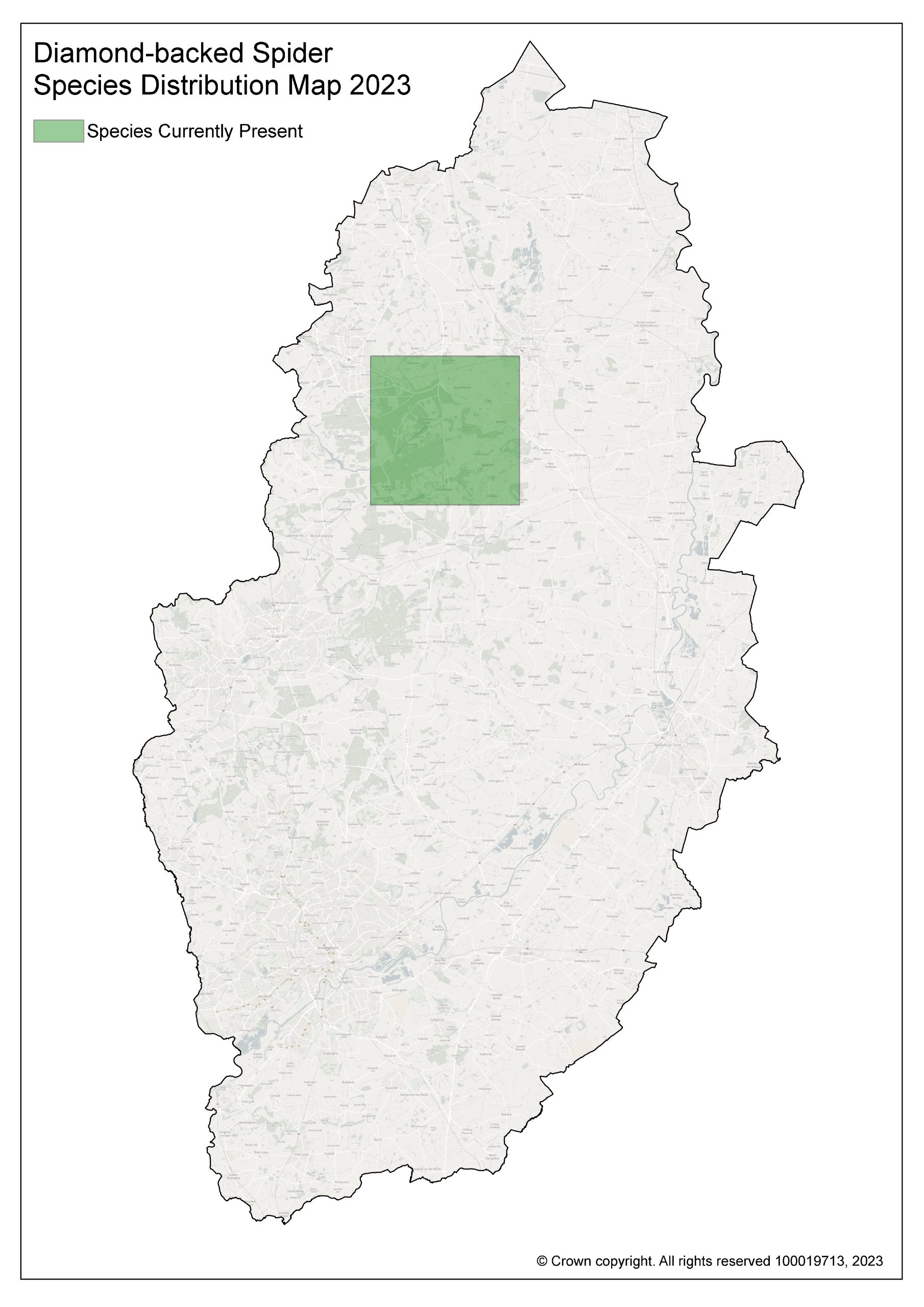
Clumber Park, Nottinghamshire, is currently the only known site for the Diamond-backed Spider (Thanatus formicinus) in Britain. This species was formerly recorded from two areas of lowland heathland in southern England. It was first recorded from the New Forest, Hampshire, in 1894 and subsequently in the Ashdown Forest, East Sussex, between 1900 and 1969. Despite targeted searches, it has not been recorded there for over 50 years. When the most recent Red List of Britain’s spiders was published in 20171 the species was assessed as Critically Endangered (Presumed Extinct). Remarkably, in September of that year a single specimen of Diamond-backed Spider was discovered, 300 kilometres north of the former sites, in heathland at Clumber Park.
Subsequent surveys at Clumber Park have found the spider in what seems likely to be a continuous population with an area of occupancy of only around 5 ha. A wider survey of potentially suitable areas of heathland at Clumber Park and adjacent Budby South Forest in 2019 and 2021 failed to find any additional sites.
Targets
- Maintain current (2017-2023) distribution of this species.
- Double the current area of occupancy within the Clumber/Sherwood complex by 2027.
- Increase the number of sub-sites for the spider within the Clumber/Sherwood Forest complex to two by 2027.
Threats
- Any rapid population decline in a species with such a restricted extent of occurrence leaves it intrinsically vulnerable to extinction. Declines could result from a range of factors including deterioration in habitat, unfavourable weather conditions and, potentially, disease, parasitism and predation.
- Catastrophic, stochastic events such as fire could easily result in extinction if the spider is, as currently thought, restricted to a single, small area of heathland. If this is the full extent of the British population, there is no possibility of recolonisation.
- Inappropriate management of the Heather (Calluna vulgaris) stands to which the spider appears to be largely restricted.
- Severe Heather Beetle (Lochmaea suturalis) attack resulting in major loss of cover.
Current initiatives
- Survey and systematic monitoring to a) establish the full extent of the population in the Sherwood/Clumber area; b) understand annual variation in abundance (as a basis for measuring long-term trends) and c) establish life-history phenology.
- Provision of expert advice, training and other support to the National Trust and other relevant organisations, by the British Arachnological Society (BAS).
- Habitat improvement by increasing the Heather cover at Clumber Park is ongoing as part of National Trust’s site management for the SSSI.
Proposed action
Policy and legislation
- Although this species is currently Red Listed in Britain as Critically Endangered1 it has no legal protection. However, this is likely to change when the new Schedule 5 list of the Wildlife and Countryside Act is announced (expected 2023/24) following the 7th Quinquennial Review in 2021.
Site safeguard and management
- The area where Diamond-backed Spiders are found at Clumber Park is currently maintained as heathland by the National Trust, working in partnership with Natural England.
- Specific provisions for Diamond-backed Spider should be included in existing and future management planning, and reviewed as new information on the species’ requirements becomes available.
Species management and protection
- Ensure a good resource of Heather (Calluna vulgaris), at what appears to be the most favourable growth phase, is maintained within, and adjacent to, the known area of occurrence.
- Identify potential areas for colonisation that can be linked to the core area, and ensure that these, and the connecting corridors, are brought into suitable condition by establishing/managing new areas of heather.
- If no further populations have been found either locally or in southern England by 2024, then IUCN2/DEFRA3 guidelines should be followed to start to evaluate the appropriateness and feasibility of both local and national translocation programmes to reduce the species’ extreme vulnerability to extinction.
Advisory
- Annual monitoring of the Clumber Park population continues to improve understanding of the status and ecology of the Diamond-backed Spider. Using this knowledge, BAS, working with NT, will produce habitat management guidelines by 2025.
- Maintain liaison between work on Diamond-backed Spider in the Clumber/Sherwood area and at its former sites in southern England.
Future research and monitoring
- Continue established monitoring programme at core Clumber Park site with, ideally, quarterly timed searches to establish both phenology, and extent of between year variation in abundance.
- Establish full extent of the population by continuing annual survey of the wider area at Clumber Park and also at other sites supporting areas of suitable habitat e.g. Budby South Forests.
- Maintain an inventory of all records detailing numbers found, if possible life-stage, and a minimum of an 8-figure grid reference, GPS reference or W3W. It is equally important to maintain records of surveys that failed to find any Diamond-backed Spiders.
- As part of the above, maintain annual training of local conservation staff and volunteers.
- Improve knowledge of the spider’s microhabitat requirements.
What can you do?
- Volunteer to help with regular monitoring or annual survey work.
- Volunteer with the National Trust and RSPB to help with practical habitat management work.
1 Harvey, P., Davidson, M., Dawson, I., Hitchcock, G., Lee, P., Merrett, P., Russell, Smith, H., 2017. A review of the scarce and threatened spiders (Araneae) of Great Britain: Species Status No. 22. Natural Resources Wales, Cardiff. NRW Spider Status Report September 2017
2IUCN, 2013. Guidelines for Reintroductions and Other Conservation Translocations. Guidelines for reintroductions and other conservation translocations | IUCN Library System
3DEFRA, 2021. Reintroductions and Conservation Translocations in England: Code, Guidance and Forms. Reintroductions and conservation translocations in England: code, guidance and forms - GOV.UK (www.gov.uk)