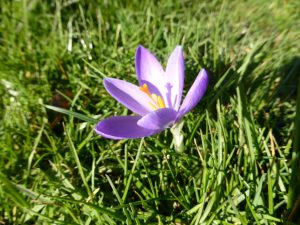
Nottingham Spring Crocus | Crocus vernus
Species Action Plan
Authors: Charlie Roberts and Kayleigh Woodhouse
Lead Agency: Nottingham City Council
Most Recent Update: January 2024
Planned Review Date: 2025
Current status
Nottingham Spring Crocus (Crocus vernus) is a native of the Balkan region of the former Yugoslavia. In Nottinghamshire, Spring Crocus is regarded as an ancient introduction, as the plant became naturalised before 1500. This species has a wide but scattered distribution in the UK. It was probably introduced for medicinal or culinary reasons, and the distribution is strongly associated with former Monasteries. It is believed that one use of the plant was to treat malaria, which was prevalent in Britain at the time, especially in areas of extensive wetlands such as the Trent Valley.
The Nottingham Spring Crocus is genetically variable, and the flowers of the naturalised populations are often composed of a range of different colour combinations of white through to purple. In horticulture, it is known as the Dutch Crocus and several named varieties have been bred.
In Nottinghamshire the species was abundant in meadows alongside the Trent, particularly in the Wilford and Dunkirk areas. Due to development in the late Victorian and early 20th Century, many of these meadows were lost. This species now occurs in small, scattered populations, within the cemeteries, parks, golf courses, meadows, old gardens and public open space in this area.
Prior to 2003, the Nottingham Spring Crocus had been recorded in 24 1km squares in Nottinghamshire. This has decreased over time, to 18 1km squares between 2004-2013 and 10 1km squares between 2014-2023.
| Period | Pre-2003 | 2004-2013 | 2014-2023 |
| No. of 5km squares | 13 | 13 | 6 |
| No. of 1km squares | 24 | 18 | 10 |
Since 1970, several of the populations recorded are abundant and several stronghold sites of the species have been identified. Notably, the Nottingham University Highfields Campus was found to have a total of 11,500 flowering spikes following a survey of two separate locations on the campus by the “Friends of the University of Nottingham” group.
The species has been introduced to 22 sites and has a strong presence in several churchyards across Nottinghamshire including Awsworth Churchyard, Nottingham General Cemetery, and Lenton Churchyard.
The Nottingham Spring Crocus’ national status is Least Concern, however within Nottinghamshire it is considered Scarce and conservation efforts are required.
Targets
- Maintain the current extent of Nottingham Spring Crocus across Nottinghamshire
- Create 1 additional site for re-introduction and complete this work by 2025.
Threats
- Destruction of remaining colonies through development of the sites.
- Destruction of remaining colonies through landscaping schemes, cemetery alterations, golf course management, provision of facilities on public open spaces.
- Changes in land management on sites, such as use of herbicides, relaxation or intensification of cutting regimes.
- Planting of cultivated Crocus species in existing colonies of Nottingham Spring Crocus, which increases both competition and the risk of dilution of the local gene pool through hybridisation.
Current initiatives
- Some landowners have been made aware of Nottingham Spring Crocus on their site and are actively taking steps to conserve them.
- Nottingham City Council's planning department has insisted on the protection of existing colonies when a development may affect colonies of Nottingham Spring Crocus.
- Nottingham City Council Parks department are undertaking a reintroduction programme within the City with support from Nottinghamshire Wildlife Trust.
- Existing populations are being mapped to determine donor sites as part of the Nottingham City Council reintroductions.
Proposed action
- Protect all known sites supporting colonies of Nottingham Spring Crocus from development/land management changes.
- Complete population estimates for the existing populations.
- Identify sites with the species present and inform landowners of their conservation importance.
- Provide advice to landowners on suitable management activities for sites once they have been identified.
- Continue the re-introduction programme into former range working with relevant partners including Nottingham University and local businesses within the Meadows area.
- Collate current information of extent and update the existing report on distribution from 2005 including population estimates.
Communication and Publicity
- Comms to be sent out after volunteer sessions to harvest crocus and re-introduce to site.
- Interpretation boards to be produced for cemetery sites displaying information on history of the species and the crocus meadow.
- Contact and collaborate with Nottingham Crocus Volunteers.
What can you do?
- Report any sightings of Nottingham Spring Crocus to the Nottinghamshire Biological and Geological Records Centre.
- Get involved in volunteer opportunities to monitor and manage existing sites and helping to create of new sites. For example, with Nottingham City Council or CART volunteer days.
First published August 2004 - Craig Fyfe Howat