
What is the current problem?
Nottingham City Council (NCC) own and manage many parks and nature reserves throughout the city that support biodiversity. Giant hogweed is not a species that is widespread in Nottingham City and as far as the council are aware, other than a few individual plants that are dealt with as soon as they are recorded, it has only persisted at one NCC owned site, Broxtowe Country Park.
It had previously been recorded at Hucknall Road Linear Walkway LNR, with a small patch of approximately 10-20 plants, although this population is no longer present. At Broxtowe Country Park, there is a large and problematic population, with three locations supporting concentrations of giant hogweed. Each location has around 50-100 plants, with two areas adjacent to a stream. This has resulted in sporadic but widespread seed dispersal throughout the park. The stream is a tributary of the River Leen and plants have been discovered in recent years alongside the river, which have been dealt with by Notts BAG during ongoing Himalayan balsam removal works.
Prior to management by NCC, the plant had been in these locations for several years with little intervention to control it. As each flower from a single umbel can produce up to 50,000 seeds (which remain viable for as long as 5 years), ongoing control and long-term monitoring is required.
Issues with Removal
Due to the phytotoxicity of the plant, removal must be undertaken by experienced operatives with specialist PPE. As the plant spreads seeds so widely, it is important to try and remove the plant before it flowers using herbicide and/or manual methods.
Control Methods
Nottingham City Council use a combination of two methods for giant hogweed control, manual removal and herbicide application.
Manual removal
NCC have used this method to remove the plant from both sites. When the plants are small, the plant can be dug out, to ensure full root removal. It is important that this work is undertaken using long-handled spades and protective gloves. In some locations the plants can then be placed off the ground, such as hung up in areas of dense scrub, in order that they dry out and die. When this work is undertaken, the plants that are removed are placed in areas that are not publicly accessible, to avoid the risk of harm to humans. Additionally, the gloves used are disposed of after removal due to the phytotoxic sap.

Giant hogweed being left to dry
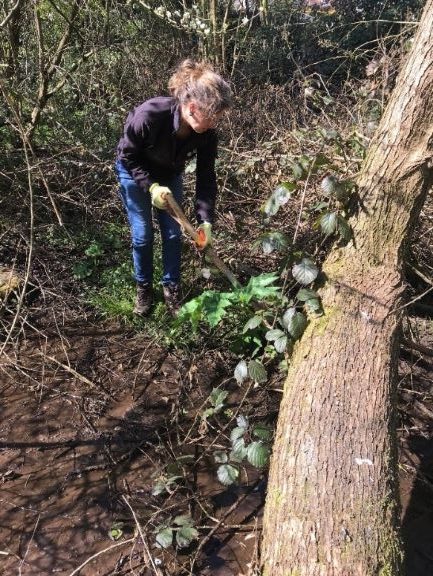
Giant hogweed being dug out
Chemical control
The application by trained, qualified operatives of specialist herbicide has proved very successful in the control of giant hogweed at Broxtowe Country Park over the last five years. This method requires at least two applications per year, and these should be undertaken in line with existing legislation and best practice. This includes seeking Environment Agency permission to use herbicides near to a watercourse. Ideally, the herbicide is sprayed on plants in their early stages of growth, before flowering to prevent further seeding. If the plants are well established, then a long-term strategy for removal is required and this should include regular monitoring.
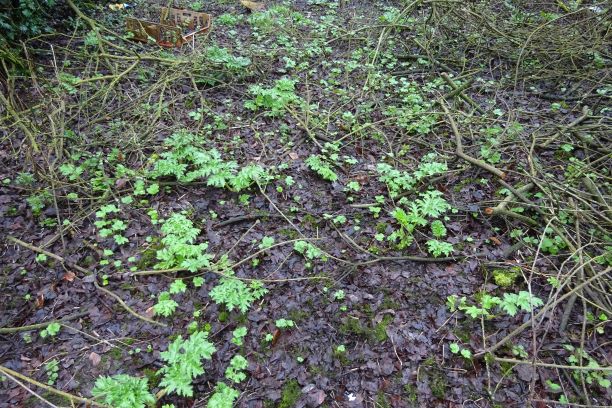
Extensive coverage of giant hogweed saplings
What has been achieved so far
The giant hogweed at Hucknall Road Linear Walkway has been under the management of NCC since 2014. Since 2017, no plants have been recorded on this site. Giant hogweed has also appeared at other sites in the city such as Bulwell Hall Park and on the banks of the River Leen in Highbury Vale. These sporadic occurrences have been dealt with immediately and no further plants have been seen in subsequent years.
At Broxtowe Country Park, the patch located away from the watercourse has been significantly reduced, with no known seeding events in the past few years. Likewise, the downstream patch of giant hogweed plants has vastly reduced from 50-100 plants when first discovered to just 13 in 2021 (these were all successfully removed). Gaps in monitoring and treatment in one of the areas at Broxtowe Country has allowed a few plants to flower in 2019 and 2020 and therefore there is now a new flush of seedlings. Treatment and monitoring will continue in these sites with the aim to eradicate the plant in the next 5 years.
If you have any further questions, get in touch with Emily Aron, NCC Biodiversity and Greenspace Policy Officer at: Emily.Aron@nottinghamcity.gov.uk