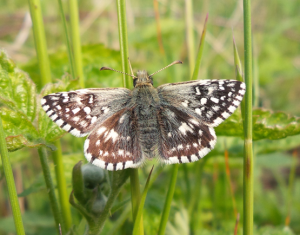
Grizzled Skipper | Pyrgus malvae
Species Action Plan
Author: Chris Jackson and Kayleigh Woodhouse
Lead agency: Butterfly Conservation East Midlands
Publication date: December 2023
Planned review date: 2025
Current status
The Grizzled Skipper (Pyrgus malvae) occurs across the South of England up to the Humber Estuary, though the species is rare outside of Central-Southern England.
In the East Midlands the Grizzled Skipper is confined to a small number of scattered colonies. Its main larval food plants are creeping cinquefoil, agrimony, wild strawberry, tormentil and silverweed. The species relies on unimproved grasslands managed by low intensity methods, preferring areas where there are bare patches of earth. Disused railway lines therefore provide ideal conditions, and in Nottinghamshire the Grizzled Skipper has the strongest colonies along both live and disused railways in the south of the county.
Butterfly Conservation report that in England, the Grizzled Skipper declined by 49% in abundance, and 51% in distribution between 1976-20191.
The species was categorised as “High Priority Regional Important” in Nottinghamshire in 2000, using criteria established by Butterfly Conservation. This was because:
- There had been a significant decline in recent decades
- There were fewer than 30 colonies remaining
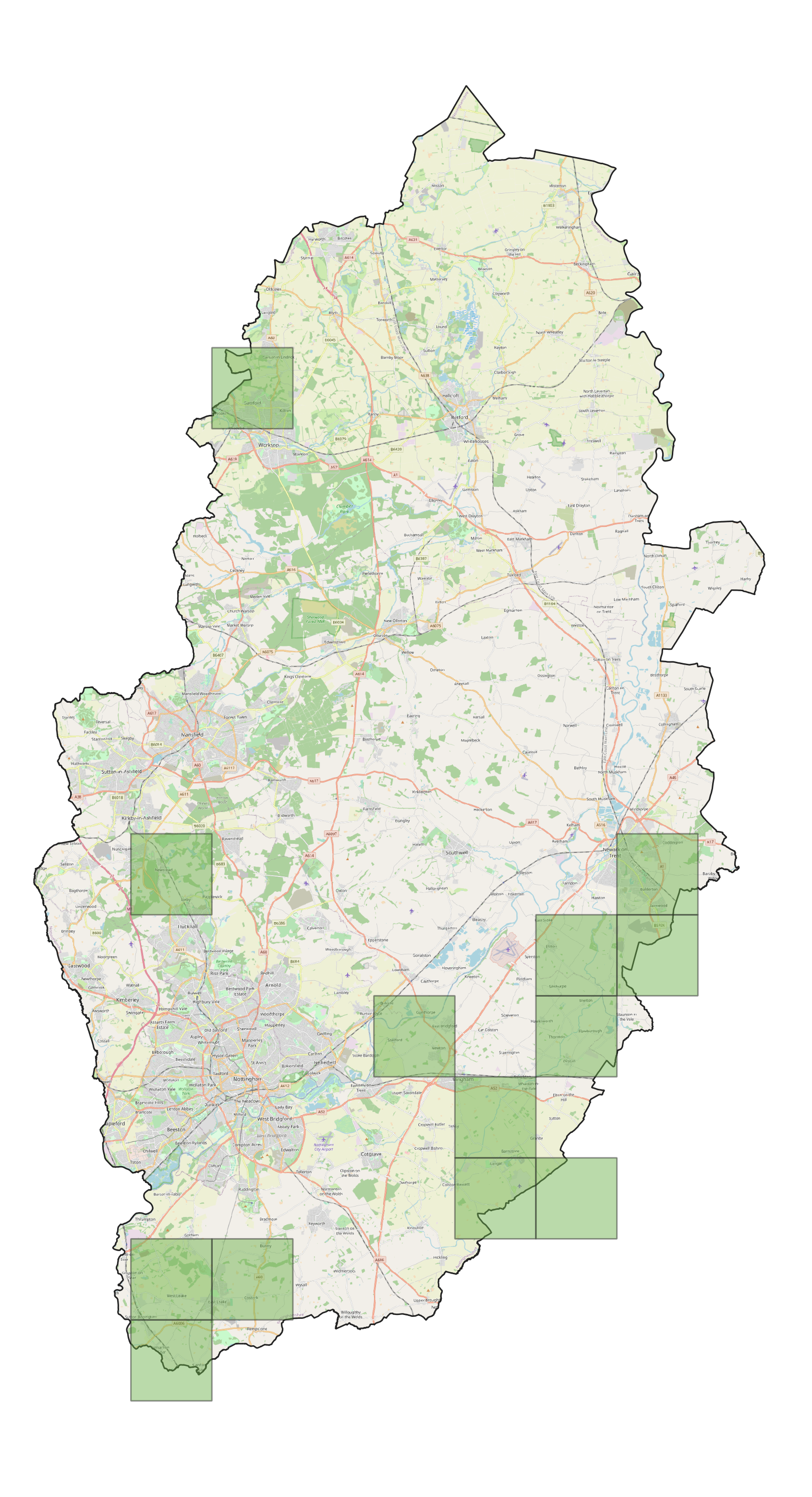
Prior to 2003, the Grizzled Skipper had been recorded in 35 1km squares in Nottinghamshire. Although nationally there has been a decline in Grizzled Skipper distribution, records from Nottinghamshire (from the Nottinghamshire Biological and Geological Records Centre, the County Recorder and Butterfly Conservation East Midland’s branch) show an increase in their distribution. Grizzled Skipper were observed in 38 1km squares between 2004-2013, and 39 1 km squares between 2014-2023. This increase in distribution however is undoubtedly a reflection of increased recorder effort over the same period.
| Period | Pre-2003 | 2004-2013 | 2014-2023 |
| No. of 5km squares | 23 | 13 | 15 |
| No. of 1km squares | 35 | 38 | 39 |
Natural colonies in Nottinghamshire are all located in the south and east of the county, and the majority are found associated with the disused railway lines running from Newark to Alverton; Saxondale/Bingham to Barnstone/Langar. The species is also found along the active main railway line west of Bingham and on sections of the steam heritage railway line, namely the Great Central Railway, in the vicinity of East Leake, which itself is rather isolated from the other colonies further east. Other sites where the species occurs include a disused airfield, former industrial areas, former gypsum works and newly planted woodlands.
Targets
- Maintain current (2014-2023) distribution of the species
- Increase distribution to 40 1km squares by 2025
Threats
- Lack of habitat management, with a loss of open areas due to scrub encroachment
- Loss of suitable habitat on disused railway lines to development, including path and cycle path construction
- Small and isolated population size making colonies vulnerable to loss and limiting the chance of recolonisation
- Loss of sites, particularly post-industrial sites, to development
Current initiatives
- The Grizzled Skipper is a Species of Principal Importance under Section 41 of the Natural Environment and Rural Communities Act (2006), making it a focus for conservation action at a national level
- A SITA Trust-funded project (£66,000) co-ordinated by Notts BAG was run between 2011 and 2013, which saw enhancement works take place on 17 actual or potential Grizzled Skipper sites
- Subsequently, the surveying and mapping of Grizzled Skippers has continued to be co-ordinated by Notts BAG on behalf of Butterfly Conservation East Midlands, and it is intended that this will continue in future years
- Notts BAG organises a group of volunteers to undertake habitat management works at key sites over the winter
- Notts BAG partner organisations have informed private and public landowners about the presence of Grizzled Skipper on their land, and given management advice to them on how best to manage areas for this species
Proposed action
Policy and legislation
- Nothing proposed
Site safeguard and management
- Determine ownership of all known sites for the species and inform landowners of their importance
- Seek to establish and implement short management plans for all sites that hold Grizzled Skipper
- Continue volunteer work parties on key sites
- Identify potential sites for colonisation and ensure that they are brought into suitable condition
- Protect all known sites supporting the species from damaging development.
- Carry out works to reduce fragmentation between populations
- Seek a ‘guardian’ for each site to report on status of habitat and management needs
Species management and protection
- Ensure that larval food plants are present on potential sites for colonisation
- Enhance egg-laying habitat through the creation of scrapes and ballast piles
Advisory
- Produce a page on the Notts BAG website for site managers, which details habitat management for the Grizzled Skipper
Future research and monitoring
- Continue the recording of Grizzled Skipper in the county
- Establish annual egg counts at key sites in order to measure year-on-year variations in population size
What you can do
- Report sightings of Grizzled Skipper to the county butterfly recorder, c/o Butterfly Conservation East Midlands
- Volunteer for practical conservation work benefitting Grizzled Skippers – contact Notts BAG
First published in 1998: Original authors - Michael Walker & Dr Alan Birch
Updated in 2016: Nick Crouch & Kelsey Simpson
1 The State of UK Butterflies 2022. Butterfly Conservation: State of UK Butterflies 2022 Report.pdf (butterfly-conservation.org)